






The modern way we build has radically changed the “ventilation game”. New (and energy-renovated) buildings are far more airtight, thanks to high-performance insulation and better windows/frames. This is excellent for energy consumption — but it comes with a catch: the air doesn’t renew itself.
Without controlled ventilation, we often see:
- increased humidity and condensation,
- mould in “cold” spots,
- unpleasant odours and “stuffy” air,
- high CO₂ levels in bedrooms/offices,
- reduced comfort and reduced human performance in the space.
This is where mechanical ventilation with heat or energy recovery (HRV/ERV) comes in: a system that brings in fresh, filtered air and removes “stale” air, without throwing away the energy we paid for heating or cooling.
1) What is HRV and what is ERV (and why it matters)
HRV — Heat Recovery Ventilation
HRV renews indoor air by recovering primarily heat from the extracted air and transferring it to the fresh supply air.
Ideal when maximum thermal “payback” is the priority (e.g. winter / colder regions).
ERV — Energy Recovery Ventilation (Enthalpy Recovery)
ERV goes one step further: it recovers both heat and part of the moisture (via an enthalpy exchanger). This helps maintain a more balanced indoor microclimate, especially where humidity plays a major role.
Bottom line (in one line):
- HRV = “keep temperature”
- ERV = “keep temperature + more balanced humidity”
2) How recovery works (the “heart” of the system)
At the centre of any recovery system is the heat exchanger — the component that “saves” energy while the air is being renewed. The operating principle differs, however, depending on whether we’re talking about centralised or push–pull (single-room) systems.

A) Centralised HRV/ERV systems (with ductwork):
Here we have two simultaneous airflows passing through the exchanger:
- the extract/exhaust air (from the building)
- the fresh/supply air (from outside)
The two streams are fully separated (they do not mix). They exchange heat — and in ERV, depending on exchanger type, also part of the moisture — resulting in:
- in winter: the fresh air is pre-heated,
- in summer: the fresh air is pre-cooled (and with ERV, better humidity balance is achieved).
B) Push–pull / single-room systems (alternating operation):
In push–pull systems there aren’t two simultaneous airflows. One fan reverses direction periodically, so the supply and extract air pass through the same ceramic core, in different operating phases. During extract, the ceramic core “stores” heat from indoor air; during supply, it “returns” that heat to the incoming fresh air.
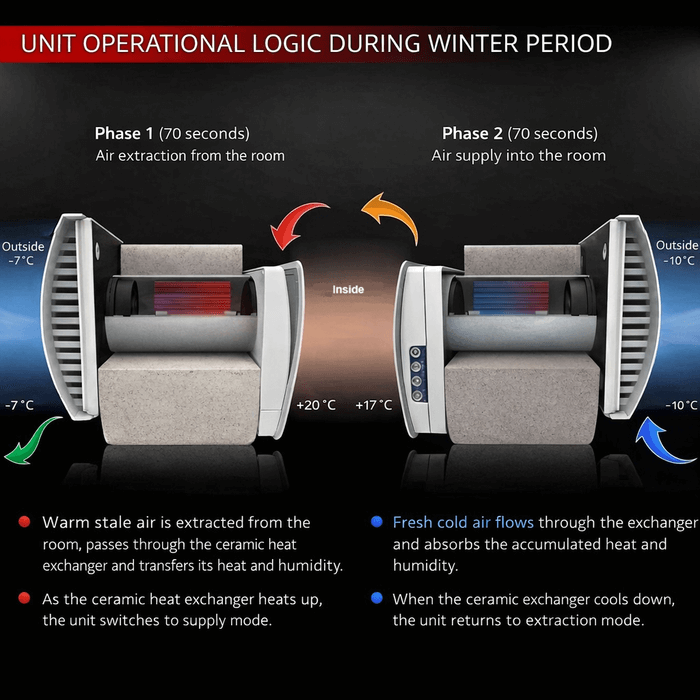
Simply put:
- in centralised HRV/ERV, flows are simultaneous and separated,
- in push–pull, recovery is alternating, using a shared core and flow reversal.
3) Why mechanical ventilation is becoming “the only way” in buildings
A) Airtightness = construction quality, but it needs controlled ventilation
The better a building “seals”, the fewer random air leakages it has. This improves energy performance, but without mechanical ventilation we trap humidity and pollutants.
B) Thermal comfort & health
Comfort is not only “what the thermometer shows”. It is also:
- oxygenation / CO₂,
- pollutants,
- odours,
- humidity,
- temperature stability.
C) Legislation / European direction
European policy is pushing towards very high-energy-performance buildings and better indoor environmental quality. The revised Directive (EU) 2024/1275 (EPBD recast*) aims to improve the energy performance of buildings and reduce emissions, with a clear direction towards a “zero-emission building stock” by 2050.
*The Directive was published in the Official Journal on 8 May 2024 and entered into force 20 days after publication (i.e. 28 May 2024). (eur-lex.europa.eu)
“The practical way to comply in new/renovated airtight envelopes is not ‘opening windows’, but designing ventilation properly as a technical system.”
4) Ventilation system architectures: Centralised vs Decentralised (Single-room / Push-Pull)
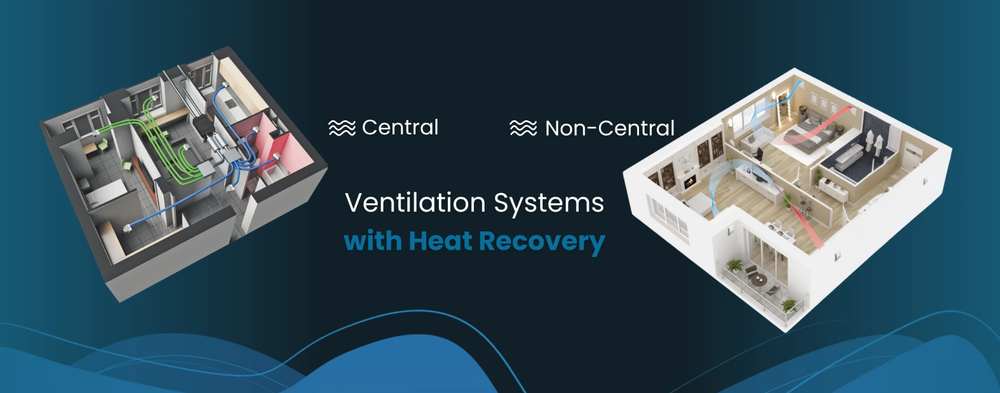
In practice, there are two main approaches.
4.1 Centralised systems
One unit serves the entire house/apartment through a network of ducts.
Advantages:
- single-point control and balanced airflows,
- filtration at a central point,
- advanced automation potential (sensors / scenarios),
- ideal for full-home coverage or larger installations.
4.2 Decentralised / single-room (often push-pull)
One unit per room, without ducts, installed through an external wall penetration.
Advantages:
- much simpler installation (ideal for renovations),
- independent control per room,
- reduced duct-network design requirements,
- low fan power thanks to direct supply/extract.
Practically: If we’re building new or doing a major renovation → centralised is the complete solution.
If we want a targeted solution without ductwork → single-room is often the smarter path.
5) HRV vs ERV: Selection comparison table
|
Feature |
HRV (heat exchanger) |
ERV (enthalpy exchanger) |
|
What it recovers |
Heat |
Heat + part of moisture |
|
What I gain |
maximum “thermal payback” |
more balanced humidity microclimate |
|
Summer |
pre-cools fresh air, but humidity can “come in” more easily |
helps better manage humidity / reduces AC latent load |
|
Winter |
excellent thermally, but can “dry out” indoor air more |
reduces the feeling of dryness, keeps indoor humidity more comfortable |
|
Best fit |
colder regions / need for maximum heat recovery |
Mediterranean climates / coastal areas / spaces needing humidity management |
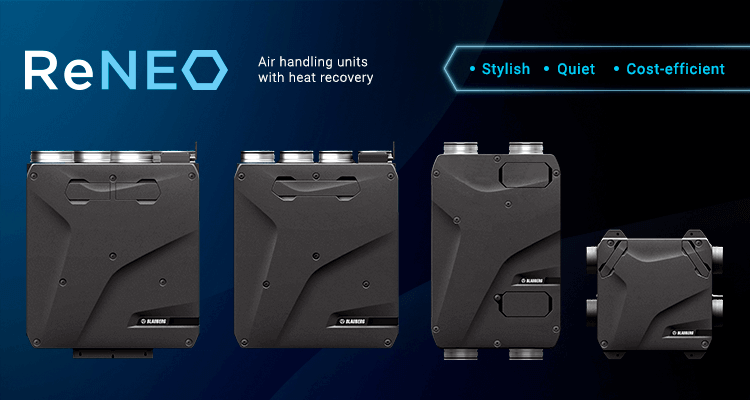
(Note: There are series/versions, e.g. the RENEO central ventilation series by BLAUBERG, where the exchanger type differs as “-E” (enthalpy), and respectively as polystyrene for sensible heat recovery.)
6) The Greek reality: what changes the choice in practice
Greece has strong seasonality and major regional differences (mountain / inland / coastal). So the right choice is not “which one is better in general”, but which one is better for this specific building and application.
Factors that make the difference
- Moisture generation indoors: people, cooking, showers, drying clothes.
- Insulation & airtightness: the better the envelope, the clearer the benefits of HRV/ERV.
- Use case: home, Airbnb, office, restaurant, school, hotel, industry.
- HVAC system: heat pump, VRF, fan coils, underfloor, etc.
- Location: coastal cities (humidity) vs inland (drier winter).
✅ Rule of thumb:
- If your main “problem” is heat loss → choose HRV.
- If your main “problem” is humidity / comfort / AC load → choose ERV.
7) The Blauberg solution range: from one room to industry
Blauberg is a German brand with a history starting in Trier in 1952. It has 15 subsidiaries, 3,500 employees, presence in 123 countries, and 210,000 m² of production facilities.
Its philosophy is based on innovation, reliability, energy efficiency, and modern automation/control (including Wi-Fi solutions where applicable).

At solution level, the approach is “holistic”: from residential to commercial/industrial and from single-room to centralised units, along with ducts/distribution systems.
7.1 Residential single-room / push-pull
Ideal when we want:
- a fast solution without ducts,
- targeted treatment of humidity/mould,
- renovation with constraints.
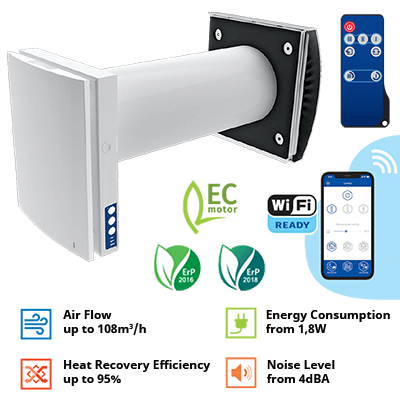
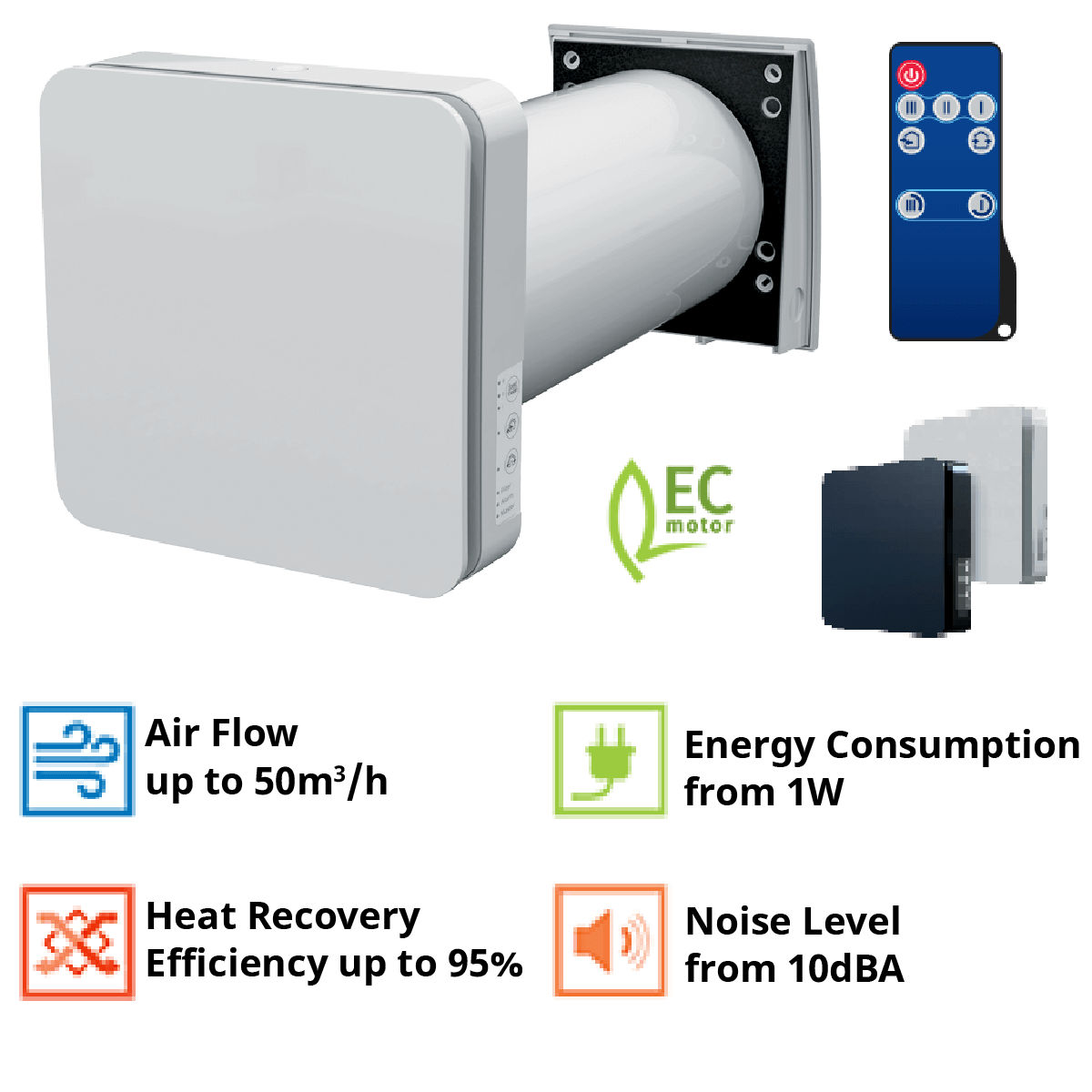
Indicative single room heat-recovery ventilation models from BLAUBERG
7.2 Residential centralised (series such as RENEO)
For full home/apartment coverage, with ductwork and controlled airflow per room.
For example, in the RENEO category there are solutions from 130 m³/h to 660 m³/h, covering different home sizes and project needs.
7.3 Commercial applications
Offices, retail, food & beverage spaces: higher occupant/odour/CO₂ loads → proper ventilation is “functionality”, not a luxury.
7.4 Industrial applications
High airflow rates, regulatory requirements, reliable operation, and proper air management.
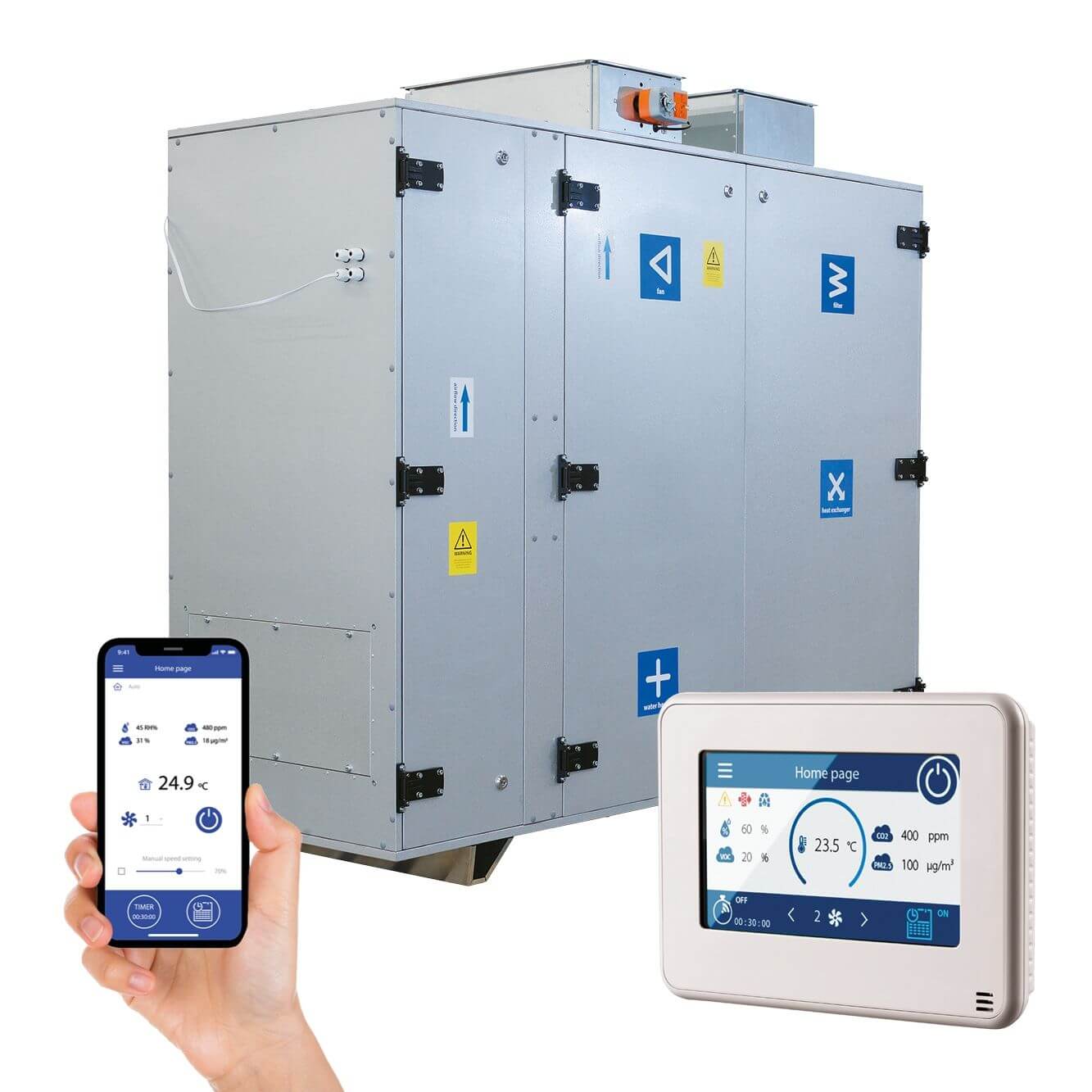
Blauberg BlauAIR CFV series: Vertical floor-standing commercial AHUs (Air Handling Units) with heat recovery, sound-insulated casing, EC motors, automatic bypass, and BMS integration via BACnet protocol.
8) The role of ductwork: why the network is “half the system”
In centralised solutions, the unit is the “machine”, but the result also depends on a properly designed duct network:
- low pressure losses,
- proper airflow distribution,
- low noise,
- good airtightness.
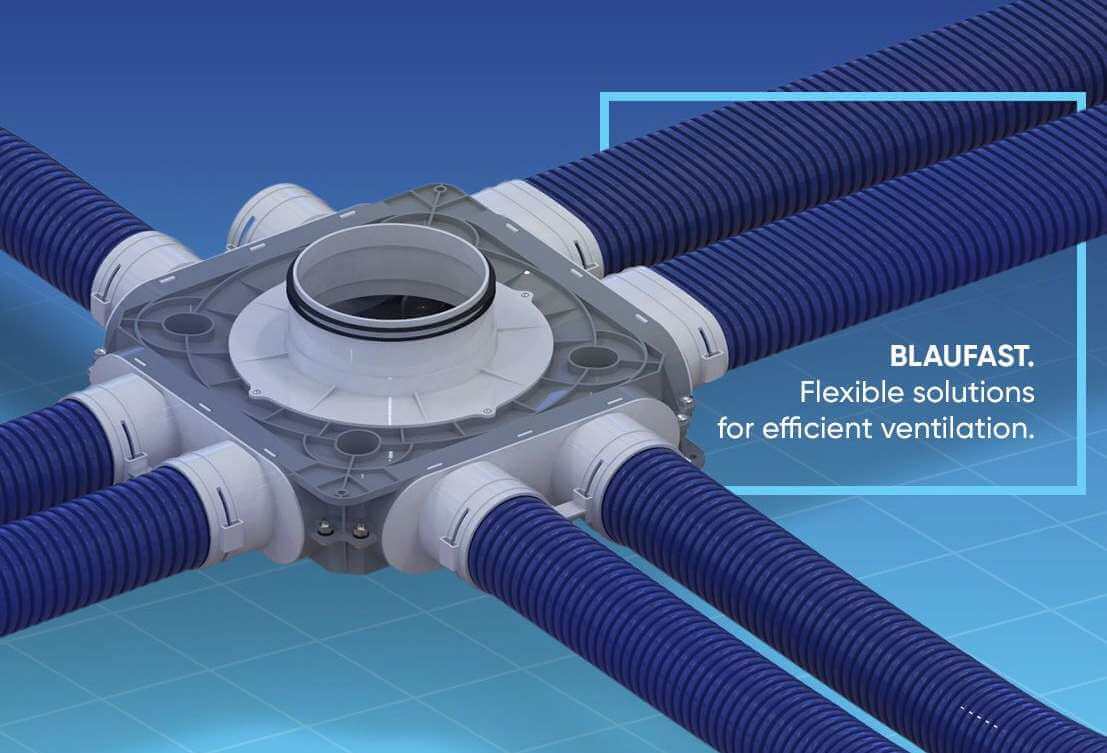
That’s why a complete distribution system such as BlauFast adds real value: a modular flexible duct and accessories system for efficient installation
9) ANDRIANOS & BLAUBERG: a complete technical solution, not just a product sale
ANDRIANOS, as Blauberg’s representative in Greece and Cyprus, does not approach mechanical ventilation as a “box on a shelf”, but as a technical system that requires proper design and proper execution to perform. For this reason, ANDRIANOS does not act only as a commercial distributor: it is a technical company that designs, supplies, and installs ventilation systems in real projects — from residences to professional facilities. This field experience is what turns into meaningful know-how and reliable support for its partners.
In practice, this means every solution is based on:
- correct airflow design (m³/h per room and total),
- correct HRV/ERV selection by climate and usage,
- proper duct network design (where required),
- proper installation, commissioning, and maintenance.
Additionally, local stock and immediate availability reduce the risk of project delays — a critical factor especially in renovations and deliveries with tight timelines.
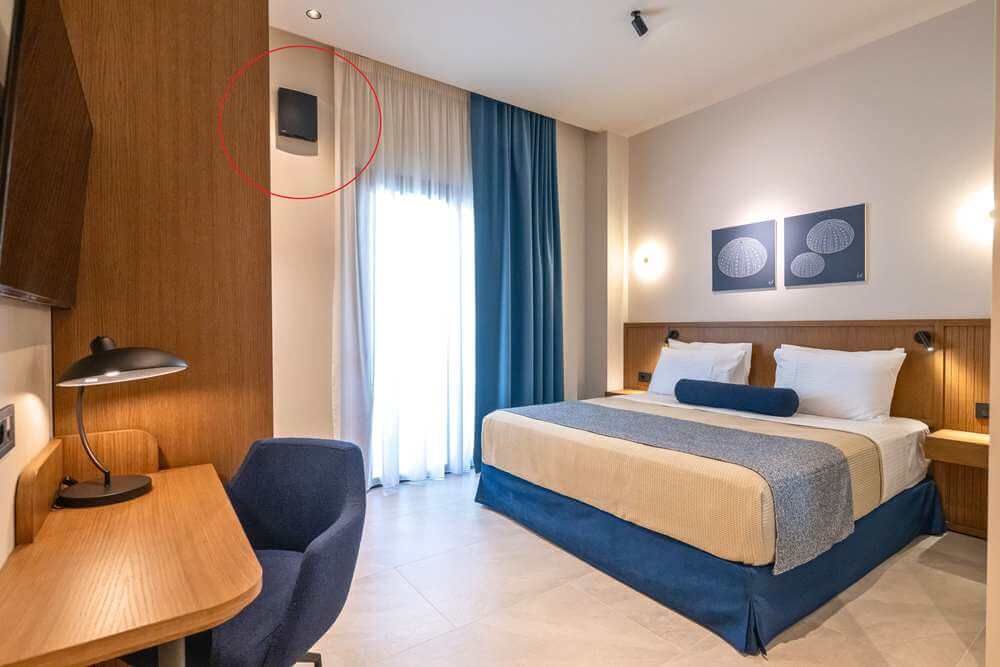
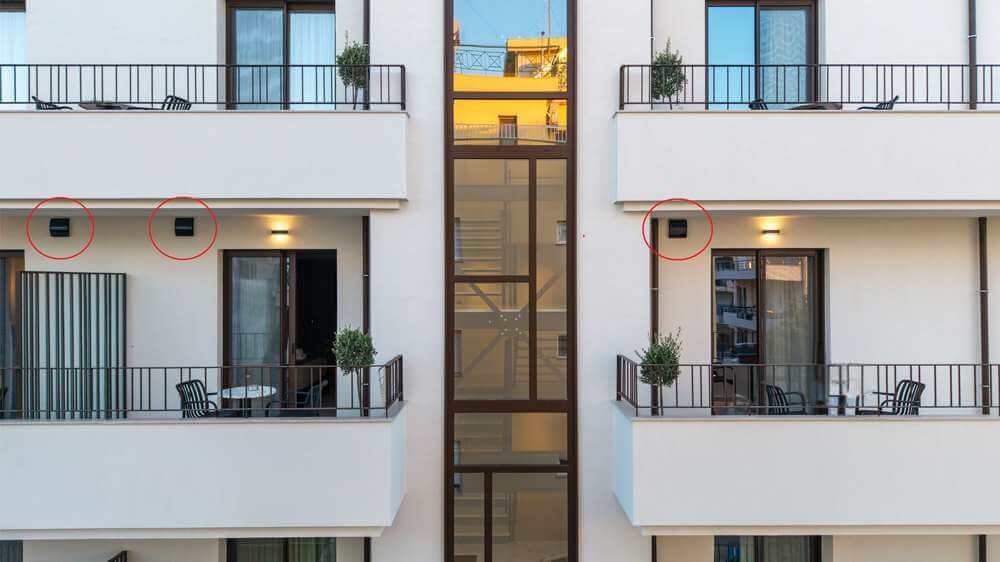
Mechanical Ventilation with Single Room / Push Pull Blauberg Vento Expert in a hotel – a recent ANDRIANOS project in a zero-energy building (ZEB)
10) Practical selection guide (quick decision matrix)
|
Project scenario |
Recommended direction |
|
New home / major renovation with ductwork feasibility |
Centralised whole-house system |
|
Renovation with constraints, no suspended ceilings / no routes |
Single-room / push-pull per room |
|
Coastal area with high humidity & summer air-conditioning |
ERV (where appropriate) for better humidity balance |
|
Area with a “heavier” winter / target maximum heat recovery |
HRV as the primary choice |
|
Offices / gathering spaces (CO₂, comfort, productivity) |
Central/commercial solutions with sensor/scenario control, for perfect regulation of CO2 level and relative humidity (RH) |
Conclusion
Mechanical ventilation with heat/energy recovery is not “just another system”. It is the prerequisite for a modern airtight building to function properly: health, comfort, humidity control, and reduced energy losses.
Blauberg offers a complete ecosystem of solutions — from single-room to centralised units for residential / commercial / industrial use, plus distribution systems — and ANDRIANOS turns that into proper application: study, selection, correct installation, and after-sales support, so the result is measurable and reliable.
Written by: Georgios Ch. Andrianos, Electrical Engineer (Aristotle University of Thessaloniki), Owner / CEO, ANDRIANOS
```


